
AI, end to end
Every specialized agent working inside your workspace, every MCP server exposing the same data to your own tools, and every way to build further on top of VALORIO.
AI in VALORIO isn't one chat window bolted onto the side of the product — it's three layers working together: agents that do first-pass drafting work inside the app, MCP servers that expose the same underlying data to whatever AI tooling your own team already runs, and a general-purpose API for teams who want to go further than either.
The agents working inside your workspace
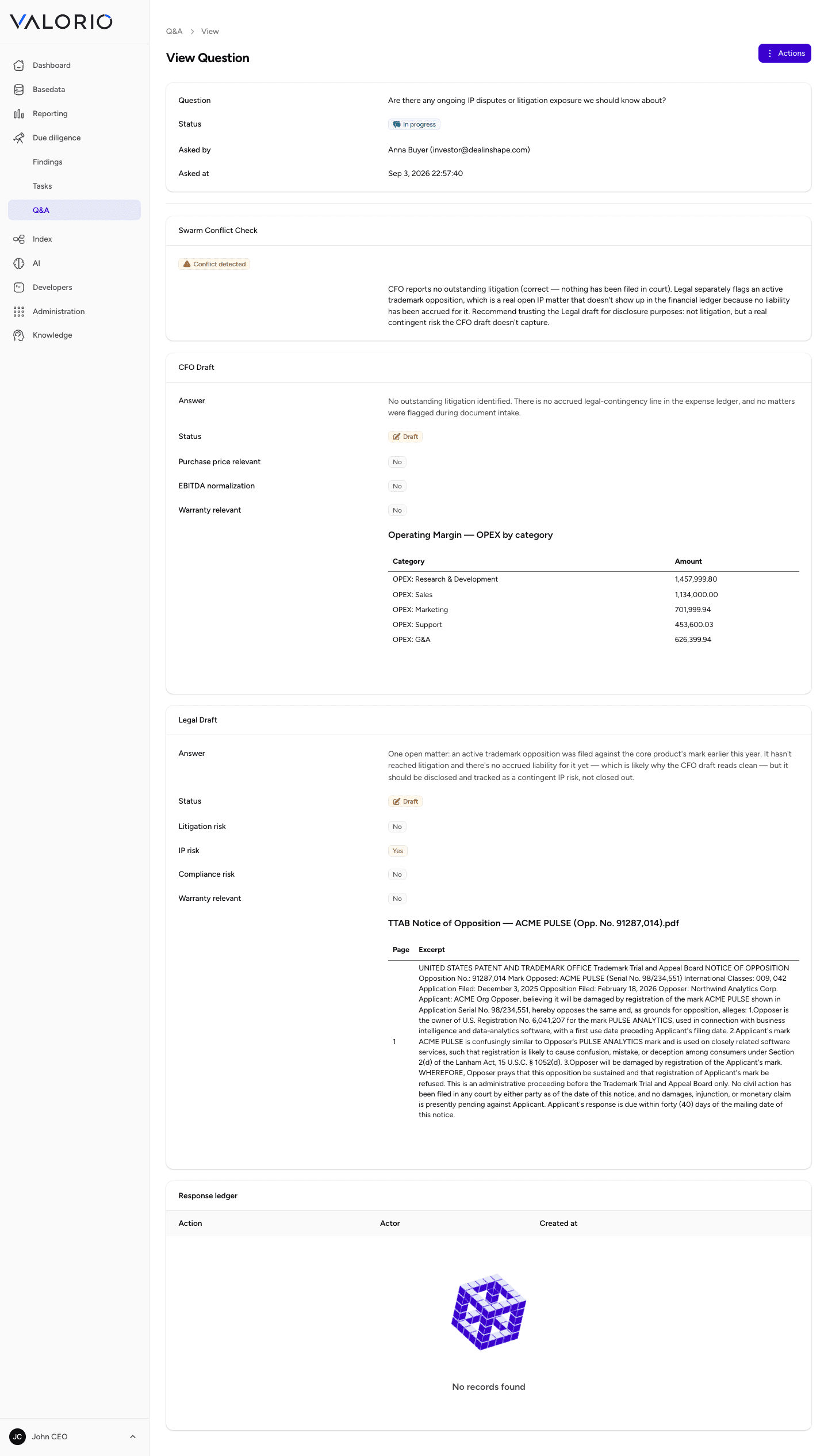
Every buyer question in the Q&A queue can be drafted by a specialized agent rather than a blank page. The CFO Agent drafts from a financial lens — pulling straight from the workspace's own reports and documents — and flags whether its answer is purchase-price relevant, touches EBITDA normalization, or involves a warranty. The CLO Agent drafts the same kind of question from a legal lens instead, flagging litigation, IP, and compliance risk.
The CTO Agent covers technical due diligence — grounded in the workspace's own answered technical questionnaire as well as its data-room documents — and flags technical risk for anything a reviewer should double-check before it goes out.
Run any two or three of them at once on the same question — swarm mode — and a conflict-check agent compares every draft against the others automatically. Most of the time they agree and a seller just reviews and sends. When they genuinely disagree, that conflict is surfaced explicitly, and an M&A Advisor agent recommends which draft to trust, with its reasoning shown alongside the recommendation, not just a verdict.
For anything that doesn't fit a single report, the Mesh IQ agent reasons across two or more reports at once and answers in plain language — including generative requests like a multi-year forecast — with citations back to the exact rows its answer draws from.
MCP servers: the same data, for your own AI
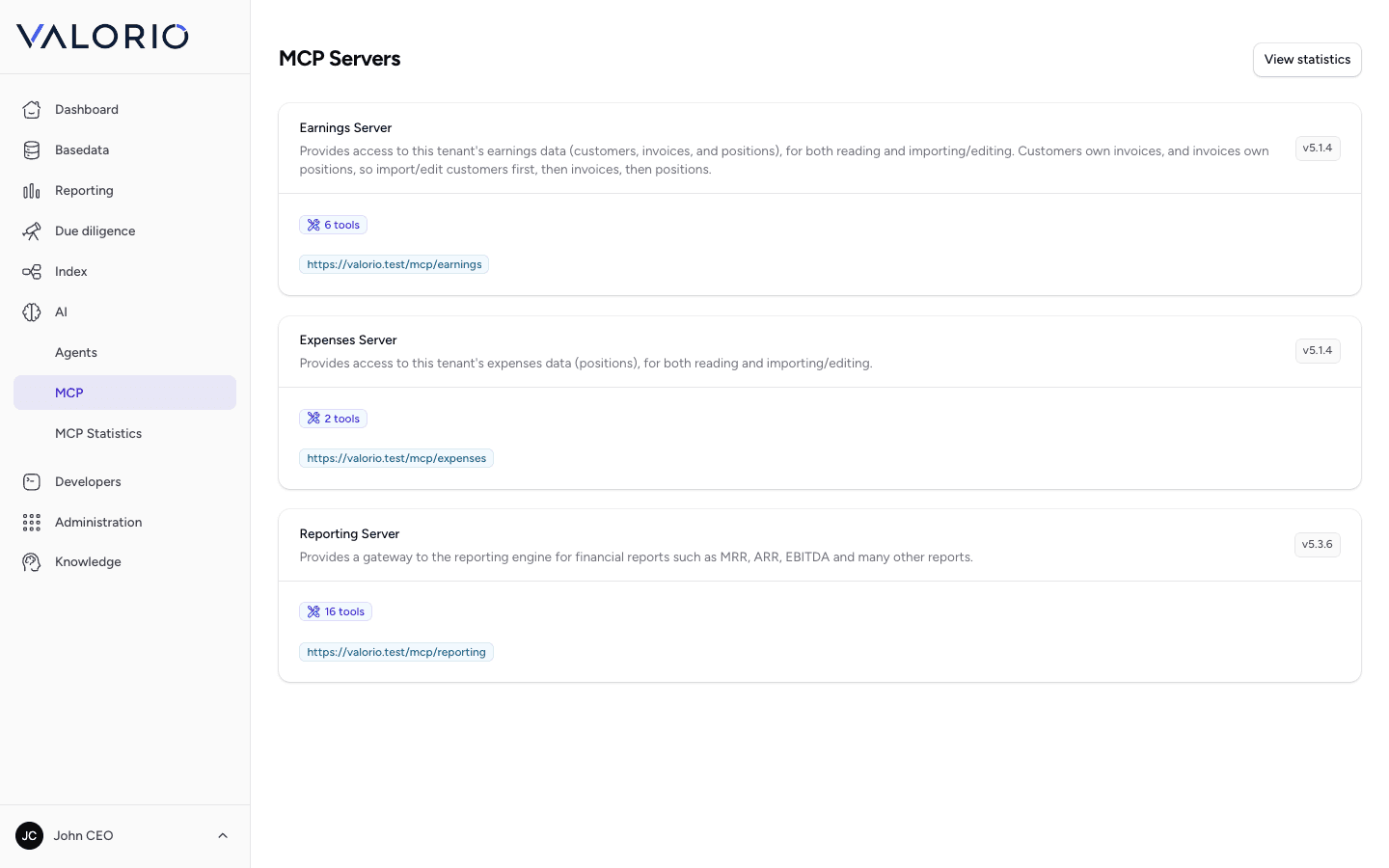
Every tenant gets its own dedicated MCP servers — Earnings, Expenses, and Reporting — each with a real endpoint URL and its own versioned tool count. Point any MCP-compatible client at them — Claude, an internal agent your team has built, anything that speaks the protocol — and it can read, and where enabled import or edit, the same customers, invoices, positions, and computed reports the in-app agents themselves work from.
There's no separate export step and no second copy of the data to keep in sync. A prompt like “build me a dashboard from the reporting MCP server” calls the same live tools — mrr(), arr(), ebitda(), ltvByCustomerCategory(), and more — that generate the numbers you see inside the app.
Extending the platform yourself
For teams who want to go beyond what an AI agent does on its own, VALORIO's Developers surface is the same general-purpose layer the in-app product is built on:
- API keys — scoped to a single workspace, created, rotated, and revoked independently, so one integration can be cut off without touching any other.
- Webhooks — get notified the moment something happens (a document uploaded, a question answered, a finding created) instead of polling for it, with a full delivery history for every attempt.